Hey dudes ,sustainable digitization is not top-of-mind for all entrepreneurs yet. This is why I focus on knowledge to flip tech firms into becoming businesses that help scale the circular economy. I try to inspire entrepreneurs into taking action, and there is one topic that keeps coming back. Many find it hard to imagine what impact their business is able to make on a global scale and above all how to get there. To be able to imagine action, it is good to see the bigger picture on Corporate Sustainable / Social Responsibility . As a tech firm, that bigger picture starts with five foundational solution strategies. These help you to develop your business model into doing more good as a tech business.
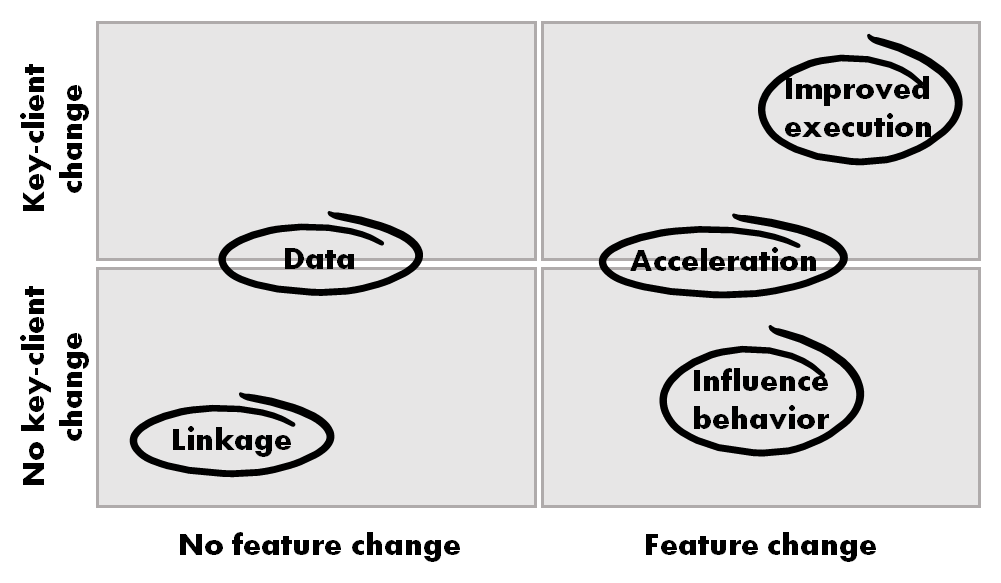
Those five strategies are a frame that any tech business could adopt to move the needle around CSR. They are grouped at the level of being different in technical complexity or market challenge, product and market fit, required value networks, etcetera. Thus adopting one of these foundational strategies assures you a clear guidance in your execution, as a strategy should do.
1. Solutions that are linked to support other cause(s)
The first and most straightforward solution strategy is formed by linkage. In this approach you do not per se put your own software solution into the execution of doing more good as a company. In this strategy you adopt an already available cause and link that to your success. For example you donate money or manpower to an active NGO based on certain business metrics you achieve. This way your tech business success is linked the success of the NGO fighting for that goal, making it your CSR-goal as well.
Some say that this cannot be called a foundational tech strategy. The tech is not actually servicing the good in itself. In my opinion no one should be nitpicking on this terminology alone. To me we should focus on the goal. When every (tech) business out there would be doing this, we would all benefit. On top of this I think that many entrepreneurs are by default hesitant to pivot their core company strategy. This course we see many small steps and those will eventually lead to more CSR tech strategies down the road.
But that being said, of course it is important to keep an eye out for greenwashing through this concept! That will not be the case when you actually get solution-skin in the sustainability-game, as the next strategies will support.
2. Solutions that drive Data/Insights
A perfect strategy to incorporate CSR into existing solutions is surfacing data to support insights to do good. When the core usage of your tech solution supports in surfacing CSR-applicable information, there is great future in this approach. Many of the Sustainable Development Goals for instance, still rely on vast amounts of data to get a clearer picture of what the status of the goal is within the world. With data coming in through existing lines of business, we build a view on a course of action.
Take for example improving the environment. For the right NGO that wants to design action into sustainable transportation, data is key. Getting real life data from cloud platforms that inform on the actual practice of transport movements could be their foundation. This way such a tech business does not have to change its core features. It does not have to change its customer base or the way it supports their trusted users. It only has to surface available data to support a good cause in designing action.
Of course you can also take it a step further and start releasing proprietary reports based on your own data. This way your brand becomes more activist by exposure.This should fit your overall market position and strategy off course.
3. Solutions that influence human behavior
The next level of using operational data for a good cause lies in the field of stimulating changed behavior. But beware, at this level you start adopting a CSR solution strategy that actually impacts the workings of your solution. Where the previous two strategies were just derived from the native workings of your solution and/or business, now you start shifting toward creating new functionality. As a basis, in this strategy you start by using the core functionality and processes of your solution, but add to try and steer people into making better decisions on day to day life.
Dream heavy, build lean, grow fast
And as usual an example makes it more clear: imagine sourcing software in the procurement realm. In the basis the users consume your software to source their business needs as before. But by adding supply chain data on sustainability and social impact per product option, you can nudge your customer base into more responsible consumption.
This way your core product positioning is unchanged. You still support the same business process as a solution and you focus on the same customer group. But the impact you can create on the global Sustainable Development Goals multiplies fast.
4. Solutions aimed at better execution
This category groups the solutions and businesses that actually play into the daily execution themselves. Think about Boyan Slat here with his Ocean Cleanup project. He took a problem and started to invent technology that is directly targeted at solving that problem. While trying to create a livelyhood from it, using venture capital investments and trying to create a non-profit brand.
This is the real hardcore tech for good scene. The inspiring examples that use their business as a do-good lifestyle. We surely need this leadership, but I have created this post explicitly to show all tech entrepreneurs that there are many more ways to support a sustainable future for our world from your business. And that can be also without having to spend all your life in inventing clean water or carbon dioxide filters.
5. Solutions aimed at accelerating dynamics
And then there is the final category, those solutions that are focusing on accelerating impact because they focus on how to turn several small ideas into bigger ones. This is a group with a wide variety of platforms and software solutions. One example is the connectivity between individuals, businesses and/or NGO’s with a comparable goal to join hands. This can be as simple as an app that facilitates calendar management to organize a road-side cleanup, but of course also more complex forms of collaboration on data and processes are possible.
Another example for this category that I think most of you will have seen are crowd funding platforms with a purpose. There are plenty examples all around the world. Crowdfunding platforms that either aim solely at private individuals to finance their do-good project or at companies that aim to have an impact in the world.
This is like putting a market place on steroids!
Discussion
Seeing or hearing these five tech for good solution strategies often leads to discussion. There are people that consider one or more of the categories no real tech for good, there are people that claim to be in multiple categories and thus disagree with it, etcetera. Discussion is good because it proves urgency.
To me these five categories or foundational tech strategies on CSR are not about being black or white. Basically the opposite, they are meant to indicate the fact that there is no black and white in this domain. Being able to make a difference is not only about creating hardcore innovative solutions that directly clean the earth or change social impact in one country or another. Above all, making a difference usually is a vast combination of separate steps. Steps to influence people, of getting financed, gathering data and being creative on how to use that data. When we see the articles on media about the high profile examples of direct impact solutions, be proud and curious on how to become part of the whole chain of events with your tech business. Do not become demotivated because you think that you can never have an impact like that.
Simply get out there and use whatever is closest to your existing business to start making an impact. No matter how small at the start, it will automatically grow over time. Either because of inspiration that you have given yourself or from inspiration and support that you have given into others.
Let’s make better tech business
